

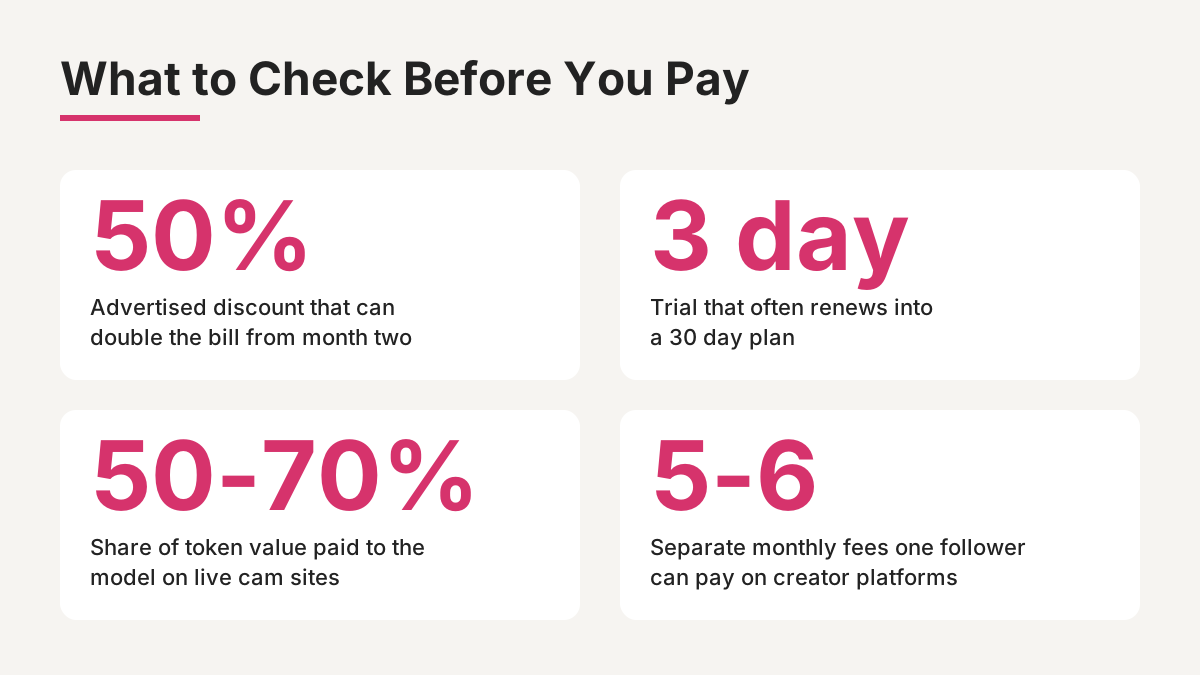
Two figures matter more than any headline price when you compare UK adult subscription sites: the renewal rate after a trial, and the number of clicks needed to cancel. A site advertised at 50% off can bill double the amount from month two, and a site with a 10 minute cancellation flow costs more in practice than one with a single button. This guide compares the main site types on price, content and billing privacy, using the checks a cautious buyer can repeat without trusting any marketing claim.
How the main subscription models differ
UK adult subscriptions fall into three broad groups. Studio networks sell access to a produced library for a flat monthly or yearly fee. Creator platforms such as OnlyFans and Fanvue charge per creator, so a single follower can end up paying five or six separate monthly fees. Live cam sites run on a token economy: you buy tokens with real money, then spend them on tips and private shows, and the model receives a fixed per-token rate, typically 50 to 70% of the token value according to common industry practice.
This difference changes how you should budget. A flat studio subscription gives a predictable cost, because the amount on your card statement is the amount you pay. A creator platform looks cheaper per account, but pay-per-view messages and tips push the real spend well above the listed price. Token sites are the least predictable of all, since a session can cost almost nothing or several hundred pounds depending on how many private shows you open.
For buyers whose main goal is a stable library of produced content, a studio network is usually the better fit. GirlsWay sits in that group: it is a lesbian site built around girl-on-girl videos, so the content focus is narrow and easy to judge before you pay. If you want to see how it stacks up against a larger catalogue, our comparison of GirlsWay vs Adult Time breaks down the library and pricing side by side.
Price and renewal: what to check before you pay
Listed prices are only the start. Before entering card details, find four numbers on the checkout page: the trial price, the length of the trial, the full renewal price, and the renewal interval. Many sites bill a low first charge and then renew automatically at a much higher rate, sometimes for a longer term than the trial implied. A 3 day trial that renews into a 30 day plan is common, and so is a discounted first month followed by a quarterly charge.
A simple spreadsheet helps. Record the site, the first charge, the renewal charge, the renewal date and the cancellation route, then set a calendar reminder two days before renewal. Over a year, the gap between a flat plan and a pay-per-item platform is often larger than the gap between any two flat plans, so compare annual cost rather than monthly sticker price.
Be sceptical of any percentage discount that you cannot verify. A claimed 50% sale is only meaningful if the full price is shown and the renewal terms are on the same page. If a site hides the renewal price until after you enter payment details, treat that as a reason to leave. Transparency on pricing is the cheapest due diligence you can do, and it filters out most of the problem sites on its own.
Content depth and how to judge a library
More titles do not mean better value. What matters is how much of the library matches what you actually watch, how often it updates, and whether the streaming quality holds on a normal home connection. A narrow, well-produced catalogue can beat a huge one that you only use for a fraction of its content.
Check three things before subscribing. First, the update schedule: a weekly release cadence is a better sign than a promise of constant new content with no dates. Second, the format: look for stated video resolution and whether downloads are included or streaming only. Third, the preview material: reputable studios show enough sample scenes that you can judge production quality without paying. Where a site offers nothing to preview, you are paying blind.
Live cam sites need a different test. Because the content is real-time, quality varies by performer and hour, so the useful questions are about the platform, not the library: how are performers verified, how are disputes handled, and how fast do technical problems get fixed. These are the same points that drive the complaints you see across the industry, from lag and disconnections to disputed token purchases.
Billing privacy and the bank statement descriptor
Billing privacy is the part of this comparison most buyers underrate. The descriptor is the text that appears on your bank or card statement, and it varies widely. Some sites bill under a neutral company name, others under a name that makes the nature of the purchase obvious. Check the checkout page or the terms for the stated descriptor, and if it is not shown, ask support before paying and keep the reply.
Consider where the statement is seen. Joint accounts, shared online banking and paper statements all expose the descriptor to other people. A prepaid card or a virtual card from your bank keeps the transaction off your main account, and many UK banks let you create single-use card numbers that cannot be charged again after the first payment. That also removes the risk of surprise renewals, which is a useful second benefit.
Data handling is the other half of privacy. Under UK GDPR, a site must say what personal data it keeps and for how long. Look for a clear privacy policy, a named data controller and a real deletion route. A site that gives you none of these has not done its basic compliance work, and you should not hand it a card number.
Age verification and UK regulation
The UK is moving towards stricter age checks on commercial adult sites. The Digital Economy Act 2017 first proposed mandatory age verification but was not fully enforced, and later online safety legislation has pushed platforms towards stronger checks. In practice, expect to be asked to confirm your age by card check, ID upload or a third-party service such as Yoti.
Treat verification as a positive signal, not an obstacle. A site that verifies users also tends to verify performers, which is the legal basis for keeping underage content off a platform. Typical performer checks include a government ID, a photo of the performer holding that ID, and tax forms, usually processed within 24 to 72 hours. Sites that skip these steps expose both you and the performers to risk.
If a site asks for an ID upload, confirm how long the image is kept and whether it goes to a third-party processor. A reputable service deletes the document after the check. If the policy is silent on this, use a card-based check instead or choose a different site.
What the affiliate data taught me about transparency
In April 2022 I compared affiliate program structures across ten cam platforms as part of a market review. Commission rates ran from 20% to 35% of referred revenue, and payment thresholds sat between 50 and 200 GBP. I read 23 affiliate agreements for compliance clauses and payment terms, and the pattern was consistent: platforms that offered real-time tracking kept affiliates about 62% longer than those that reported only after the fact.
That finding transfers directly to subscribers. A platform that is open with its partners about tracking and payment terms tends to be open with customers about billing and cancellation. Opacity on one side usually predicts opacity on the other. When two sites look equal on price and content, pick the one whose terms are easier to read, because that is the one more likely to treat a complaint properly.
Cancellation, refunds and chargebacks
Cancellation rules separate good sites from bad ones faster than any other factor. Test the route before you pay: find the cancel link in account settings, count the steps, and note whether you must contact support by email or can cancel instantly. If cancelling needs a phone call or a form that is hard to find, assume you will pay for at least one extra cycle.
Refund terms are usually narrow. Most adult sites treat digital content as consumed on access and refuse refunds for time already used, though the cooling-off rules for distance contracts can apply in some cases. Read the refund clause, screenshot it, and keep the confirmation email. A chargeback through your card issuer is the last resort, and it has costs: sites often respond by closing your account and, on token platforms, by deducting disputed amounts from performer earnings, which is why they treat chargebacks seriously.
Before you subscribe anywhere, read independent feedback. For a studio network, our pages on whether GirlsWay is safe and the recurring GirlsWay complaints show what billing issues buyers actually report, and the guide to GirlsWay payouts explains how the money side of the industry works behind the checkout.
What could be better across the category
Even the better sites share weaknesses worth naming. Renewal pricing is the largest: low trial rates followed by steep renewals are standard, and many checkout pages bury the renewal figure below the fold. Skip any offer where the full price is not visible at the point of payment.
Descriptor clarity is the second weakness. Few sites publish their statement descriptor up front, so buyers who care about privacy must ask support or test with a virtual card. Creator platforms add a third problem, cost sprawl, because per-creator fees and paid messages make the true monthly spend hard to predict. Token sites add a fourth: tokens have no value outside the platform and may expire after inactivity, so unspent balance can be lost.
| Criterion | Studio network | Creator platform | Cam site |
|---|---|---|---|
| Cost predictability | High, flat fee | Medium, extras add up | Low, spend varies |
| Content type | Produced library | Per-creator posts | Live, real-time |
| Main billing risk | Steep renewal | Paid messages | Token expiry |
For a buyer who wants predictable spend and a defined library, a studio network is the safest starting point, with the caveat that you must check the renewal price. For interaction, a creator or cam platform fits better, but set a monthly cap before you begin.
Comments
No comments yet.
Leave a comment
Your email will not be shown. Comments are reviewed before they appear.